Knowledge Rich 2.0? In Flanders’ Classrooms ….
Author: Alisdair Wade, Thinking Matters
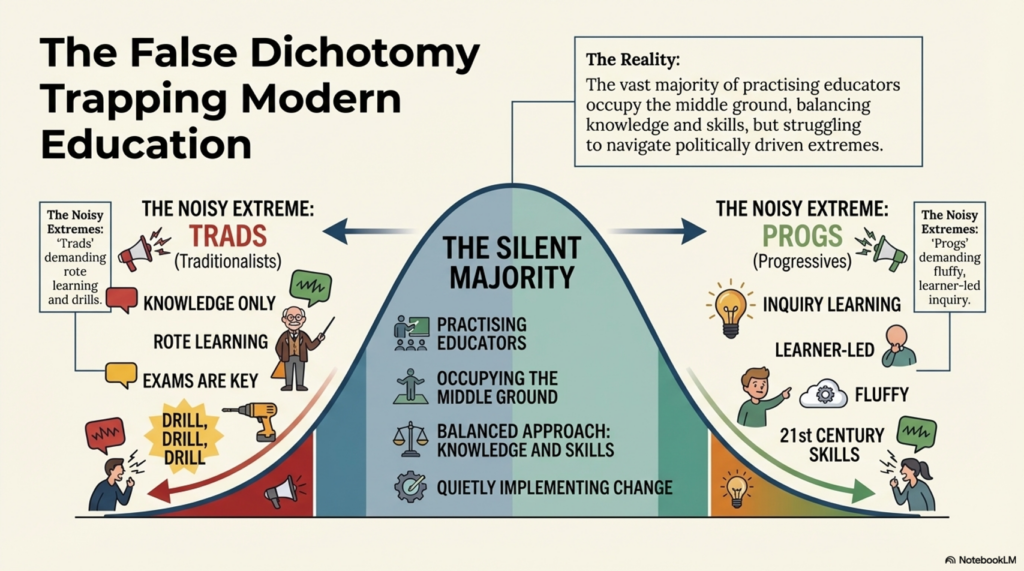
The term ‘silent majority’ suggests that it is the minorities who are the noisiest. And so it plays out in education too. The argument is ongoing as to who is ‘right’ between the ‘trads’ and the ‘progs’.
To be clear, we are looking at these groups through the caricatures they paint of each other. The progs, for instance, would claim that the trads believe: “Knowledge is the only thing. Rote learning is key, exams must be passed to get up the league tables and so all they do is drill, drill, drill.
“Antiquated,” the progs say. “Stuck in the Victorian age. Do these people not see what is coming, what is here already? Knowledge is at our fingertips with a click of a button, so why waste your time on that? We should be preparing our learners with the skills of the future, not the past.”
On the other hand, the Progressives are labelled “fluffy”, with their “non-scientifically-evidenced” ideas of inquiry learning led by the learners.
“Chaos”, the trads cry. “Do these people not know that you cannot think creatively if you have nothing to think about? Do they not understand the science of how learning works? Have they seen what happens to your PISA scores if you should dare to take this route?”
And boy, do they say it loudly…
The Reality
The reality, of course, is that neither of these noisy extremes is what the vast majority of practising educators either believe or do. They occupy the middle ground, silently, well, other than grumbling about it in the staff room. But how do you navigate it, particularly when politicians (and therefore policy) so often only react to the noisy extremes?
It is a challenge. If you believe that knowledge and cognitive science are important but that setting your learners up to thrive in a rapidly changing, AI driven world is too, then what to do? We are increasingly asked, especially from our friends in Northern Ireland, whose curriculum is hurtling there fast: “How does that fit in with the “Knowledge Rich” curriculum?”.
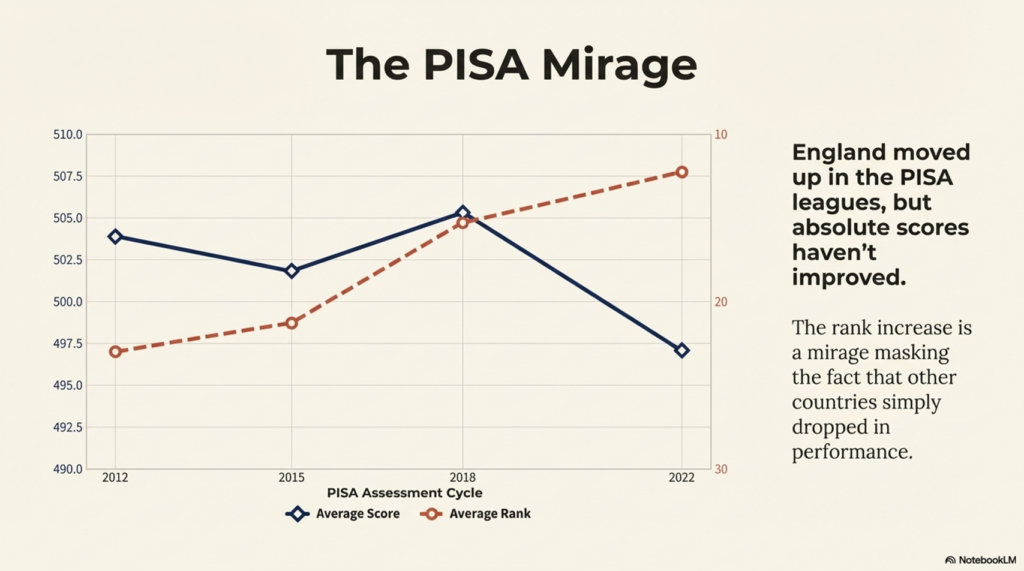
Well, to answer that, you have to go hunting and so we did. Sometimes you don’t have to hunt very far. England has been ‘knowledge rich’ for well over a decade, and, claim its supporters, look at what that has done for its PISA rankings. They would be right to point that out. England has moved up in the PISA leagues. However, there is a crucial caveat here. Its absolute scores have not actually improved; rather, other countries have simply dropped further. Which, to be fair, and with a touch of irony, at least shows resilience.
But there is another reality we must face. In England, pupil interest in school has fallen, and teachers are exhausted and voting with their feet. Implementing a rigorous, knowledge rich curriculum is incredibly demanding. It asks a lot of our students’ motivation if not done well and it asks even more of the teachers at the front of the room delivering it.
When students lack independence, the heavy lifting falls entirely on the teacher
When students are handed a mountain of knowledge without the explicit cognitive tools to process it, they become overwhelmed and disengage. And when students lack independence, the heavy lifting falls entirely on the teacher, driving up workload and burning out brilliant educators. The curriculum itself (though its content needs reduced) is not the enemy here. The missing piece of the puzzle is giving students the tools to actually manage a knowledge rich approach.
But what does ‘knowledge rich’ actually look like on the ground? Is it the soulless repetition of facts in silent rooms where teachers without any autonomy read top down, prepared lesson scripts off a teleprompter? Only if you are an extremist ‘prog’. That does happen, but it is not mainstream. It is, however, a perception that irks the knowledge rich cheerleaders. Which brings us to what might be called Knowledge Rich 2.0. Something that looks designed to say, “If you think this is just rote learning, you are wrong”. And for that, you have to hunt a little further. Flanders to be precise.
Flanders – Knowledge Rich 2.0?
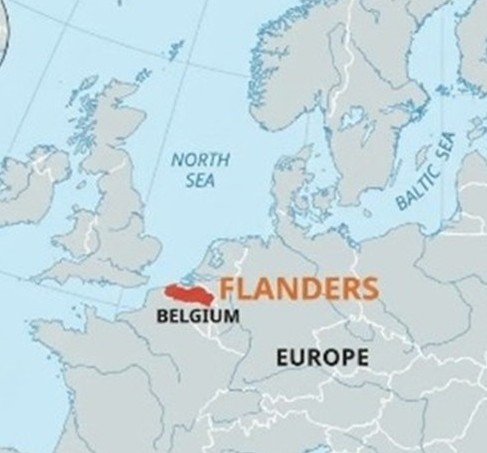
Now, for a quick geographical recap, Flanders is an autonomous region of Belgium that speaks Flemish Dutch. It is important in this context because, like Northern Ireland, it has recently said it is going to introduce a ‘Knowledge Rich’ curriculum. The first ‘voluntary’ year for the new curriculum was this school year, with it becoming mandatory in core subjects in September 2026. So, it has had a bit of a head start on Northern Ireland and therefore makes for an interesting case study. It also makes for an interesting follow because, when you dig into what it is seeking to achieve, it looks as though it has learnt its lesson from some of the implementation hurdles of the English version. That is to say, it has understood that it needs to shift away from appearing to be too ‘rote learning’ and that there is a genuine appetite for developing young people capable of thriving in the Age of AI.
Now, it does not quite go the whole hog on this. It does not seem to care too much for the explicit development of non-cognitive skills, like resilience, and there is still something of an obsession with critical and creative thinking being entirely domain specific. Nor is it explicit about how you might become, let’s say, a critical thinker beyond just becoming a subject expert. We believe there is a bridge to be built here. While critical thinking absolutely relies on deep subject knowledge, having a shared, generalist vocabulary and set of tools for how to think accelerates a student’s ability to apply that to specific knowledge, as well as freeing up vital working memory to do so.
But at least it recognises that developing these cognitive skills, and not just encoding and retrieving knowledge, is an end game. More importantly, it is really VERY good at laying out how they want schools to develop metacognitive, self-regulating learners. And this looks like it is the big difference from Knowledge Rich 1.0. The Flemish explicitly want their learners to learn how to learn. They have laid out how they want schools and teachers to go about developing independent learners. And, in our view, knowing how to learn and applying that to whatever it is we are going to have to quickly know how to do, is going to be one of, if not the key skill we will all need to thrive in the ‘new’ world.
Mastering How to Learn
In a nutshell, the Flemish Curriculum fits “Mastering How to Learn” into its knowledge rich curriculum by treating the learning process itself as a specific body of knowledge that pupils must acquire. Here is their plan:
- Treat the mechanics of learning as explicit content: Students are not just going to learn, they are going to be taught the science behind it. The curriculum explicitly requires pupils to know a “simplified explanation of how the brain works”. This includes understanding the specific biological and cognitive mechanisms of taking in and processing information, storing knowledge, and retrieving it.
- Centre learning on the importance of prior knowledge: When pupils apply cognitive strategies, they are expected to do so while explicitly taking their prior knowledge into account.
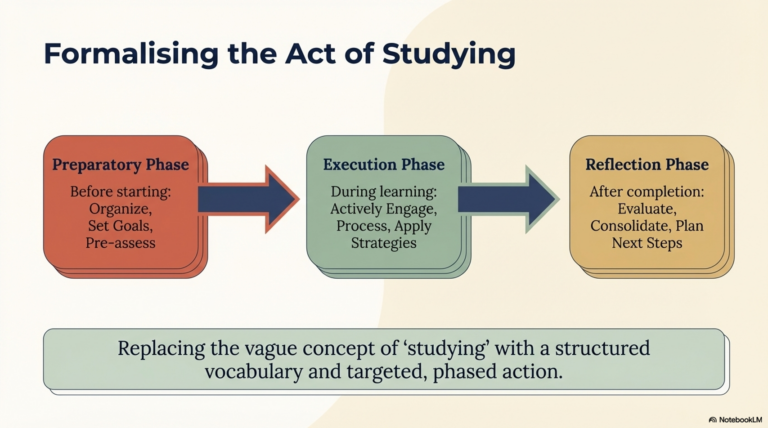
- Create a structured vocabulary for learning: The curriculum formalises the act of studying by breaking it down into distinct, learnable concepts.
- Strategies: Pupils must know cognitive learning strategies to process information actively, rather than passively absorbing it.
- Phases: Learning is taught as a defined cycle with three specific stages: a preparatory phase, an execution phase, and a reflection phase.
- Combine “Knowing That” with “Knowing How”: The curriculum bridges the gap between theoretical understanding and practical application.
- Theory: Pupils must know about the brain and the strategies.
- Practice: Pupils must apply learned and practised cognitive learning strategies and organise both their learning environment and themselves to suit the specific learning goal.
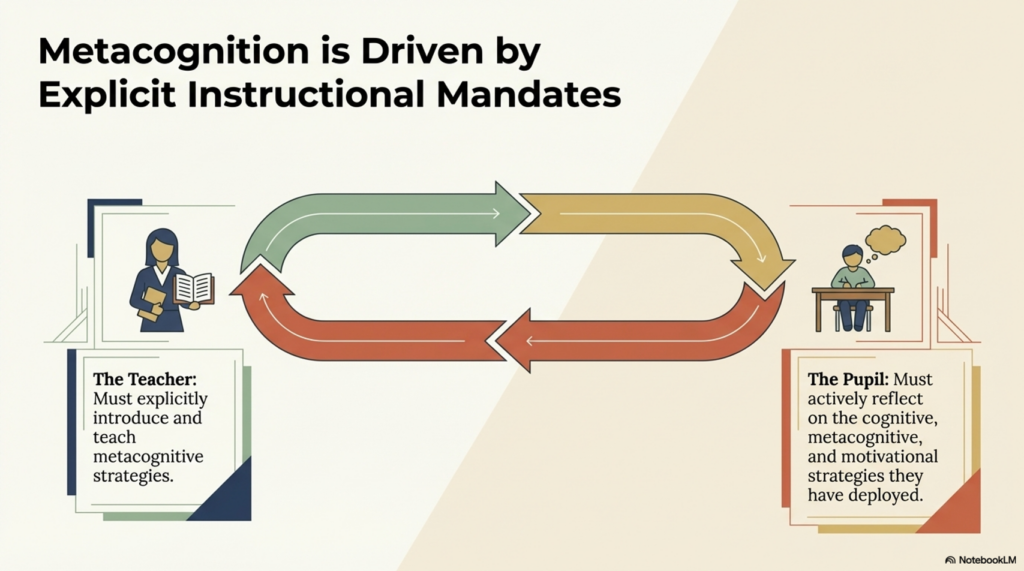
- Mandate ‘Active Metacognition’: This requires teacher led instruction on how to think about thinking. Pupils are expected to use metacognitive strategies that have been specifically introduced and taught by the teacher. This leads to a requirement for pupils to reflect on the cognitive, metacognitive, and motivational strategies they have employed.
Wow! If that is the new knowledge rich, then lucky Northern Ireland. Obviously, it is not so simple, politics and all that, but there is hope that the Northern Irish version of knowledge rich will be more 2.0 than 1.0. Why? Well, behind the evolution in Flanders is Daniel Muijs, the Flemish Professor of Education and Social Sciences at Queen’s University, Belfast and member of the curriculum Task Force Advisory Committee for the new NI curriculum. In a past life he also happened to write the EEF’s guidance document on metacognition and self-regulation.
Will his influence be enough? Who knows, but either way, what the new Flemish curriculum goes some way towards is using cognitive science to best input and cement knowledge, while also developing some vital ‘new world’ ready skills. That brings knowledge rich back from the extremes of the bell curve, providing students with the tools to manage cognitive load and giving teachers their time and joy back. Is it enough to survive lethal mutation into rote learning when it hits the ground? We’ll have to watch this space.
Don’t Leave the ‘Middle Ground’ to Chance
Meanwhile, navigating this middle ground requires a framework. At Thinking Matters, we have spent years developing an approach that does exactly what Flanders is attempting: marrying essential knowledge with the cognitive and metacognitive skills required to actually use it. Do not leave the middle ground to chance. CONTACT US
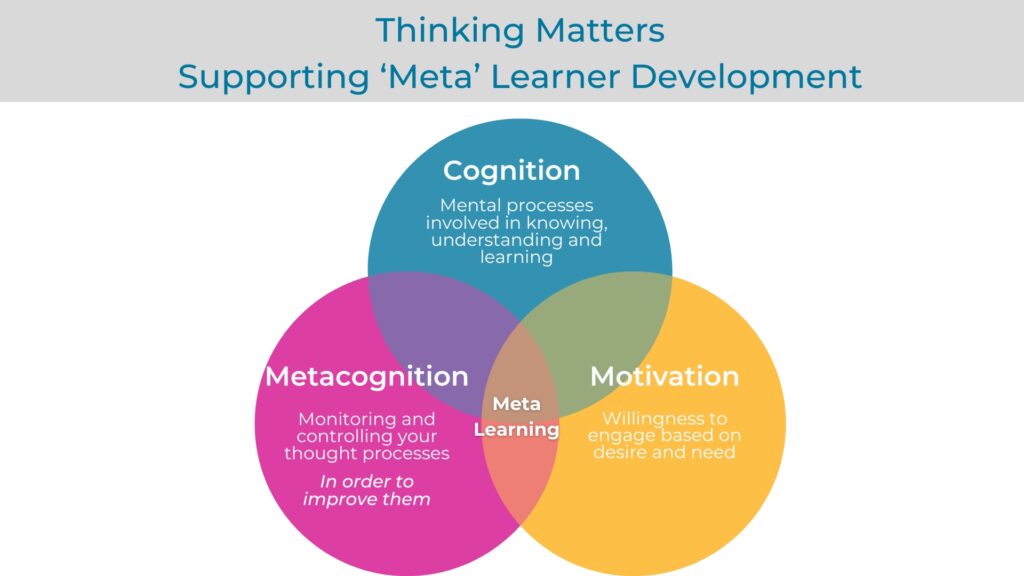
Enjoyed this article? Don’t just read about the Flanders approach, implement it! We are offering 5 schools’ senior leaders a complimentary Self Evaluation Audit to assess where they are in embedding metacognition and self regulated learning.
To claim your Audit …
FAQs
What is the difference between traditional and progressive education?
The ongoing debate often pits direct instruction and rote learning (‘trads’) against skills-based, discovery learning (‘progs’). However, the most forward-thinking schools realise this is a false dichotomy. The goal isn’t to choose one, but to bridge deep subject knowledge with advanced cognitive strategies that develop independent, ‘meta’ learners.
What exactly is a "Knowledge-Rich 2.0" curriculum?
We see Knowledge-Rich 2.0 as an evolution of the traditional knowledge-based curriculum. Rather than stopping at fact retention, it explicitly embeds metacognition and self-regulated learning frameworks directly into everyday classroom practice. This allows students to actively process, connect, and apply their knowledge independently, rather than just passively receiving it.
What can schools learn from the new Flanders education model?
Flanders is demonstrating that high academic rigour does not have to come at the expense of independent thinking. By systematically integrating specific metacognitive tools (such as the ones Thinking Matters support schools to embed), schools can achieve the measurable outcomes demanded by traditionalists while developing the adaptive, resilient learners championed by progressives.
How do we transition our school to a Knowledge-Rich 2.0 model?
Without a structured approach to metacognition, a knowledge-rich curriculum risks becoming mere memorisation. The key is implementing a ‘Thinking Thread’ – a pedagogical approach that fits your setting – which will soon allow your students to develop into independent, ‘meta’ learners who progress beyond expectations in their academics as well as future-proofing themselves for a fast-changing world beyond the school gates.
Ready to explore what this looks like in your setting? Request your free ‘no strings’ discussion around your Thinking Thread